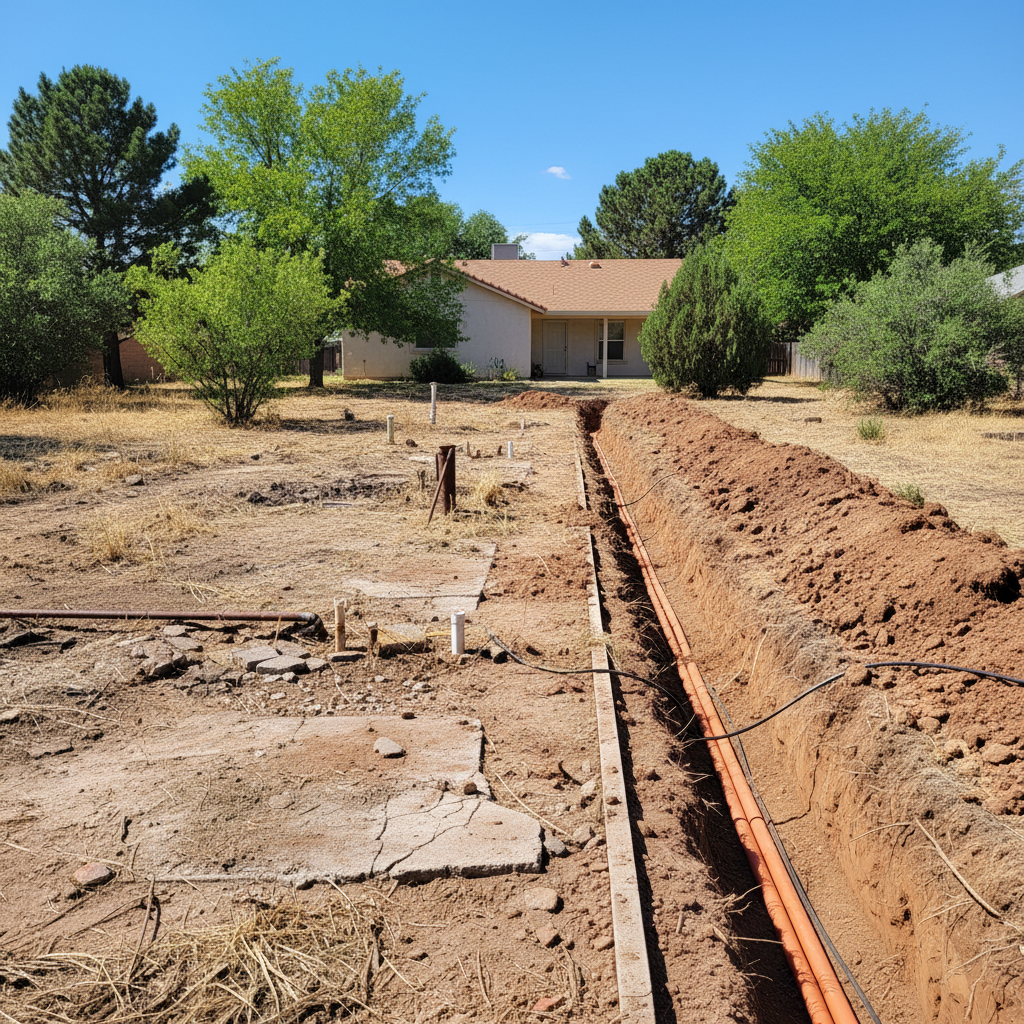
When you need to get water, power, or sewer lines installed on a property here in the Rim Country, digging a hole is not as simple as renting a machine and going to town. Around here, you are usually dealing with stubborn decomposed granite, dense clay, and patches of rock that will chew up standard utility teeth in minutes. If you are weighing your options for a utility run, you are looking at traditional open-cut trenching on one side and alternative approaches like directional boring or mini-excavator micro-trenching on the other.
The Realities of Traditional Open-Cut Trenching
Open-cut is exactly what it sounds like. Coastal Excavating Solutions brings in an excavator or a heavy-duty walk-behind trencher, cuts a clean path straight down to depth, drops your conduit or pipe in, and backfills it. Coastal Excavating Solutions uses this method for a large chunk of our residential and commercial utility work because it is straightforward and gives our team total visibility over what is happening in the ground.
The main perks of Excavating Contractor services involving open-cut are upfront cost and accessibility. It is generally the most economical choice when you have a clear path across a lot. You can inspect the bedding, make sure the pipe is graded properly, and handle standard backfill and compaction all in one workflow. But it leaves a scar across your yard. If you have mature landscaping, custom hardscaping, or a long driveway you would rather not tear up, an open trench can turn your property upside down for a few days.
How Alternative Methods Stack Up
When tearing up the surface is not an option—say you need to cross under a paved driveway or an established lawn up near Rumsey Park—alternative trenchless or minimal-impact methods enter the conversation. Directional boring, for instance, punches a pilot hole underground and pulls your line through without disturbing what is sitting on top.
Durability-wise, both methods hold up well if they are executed right, but open-cut lets us compact the backfill in lifts. That matters during our heavy monsoon seasons when rushing water loves to find loose fill and turn it into an erosion channel. Boring bypasses that issue entirely because the native ground above the pipe stays completely undisturbed.
Cost, Maintenance, and Making the Call
From a purely financial standpoint, open-cut trenching wins on price every single time. Boring and specialized trenchless techniques require specialized rig setups and extra labor, which drives up the initial bid. However, if you factor in the cost of ripping out and replacing concrete, flagstone, or extensive turf, a boring setup can sometimes pay for itself in saved restoration bills.
Maintenance comes down to installation quality. If an open trench is backfilled and compacted properly, you will not have to worry about weird sinking spots two years down the road. If it is rushed, you will be hauling in topsoil to fill settling dips after the first big winter snow melt or summer downpour.
For most standard utility runs across open dirt or gravel lots in neighborhoods throughout Payson, Star Valley, or up toward Pine, traditional open-cut trenching remains the most reliable and cost-effective route. Save the alternative, minimal-impact methods for specific obstacles like concrete flatwork or dense, irreplaceable landscaping where avoiding surface damage is worth the extra cost. Coastal Excavating Solutions provides Excavating Contractor services for homes and businesses in Payson.